14 October 2026
Met mast or foundation pour: telling them apart in satellite imagery
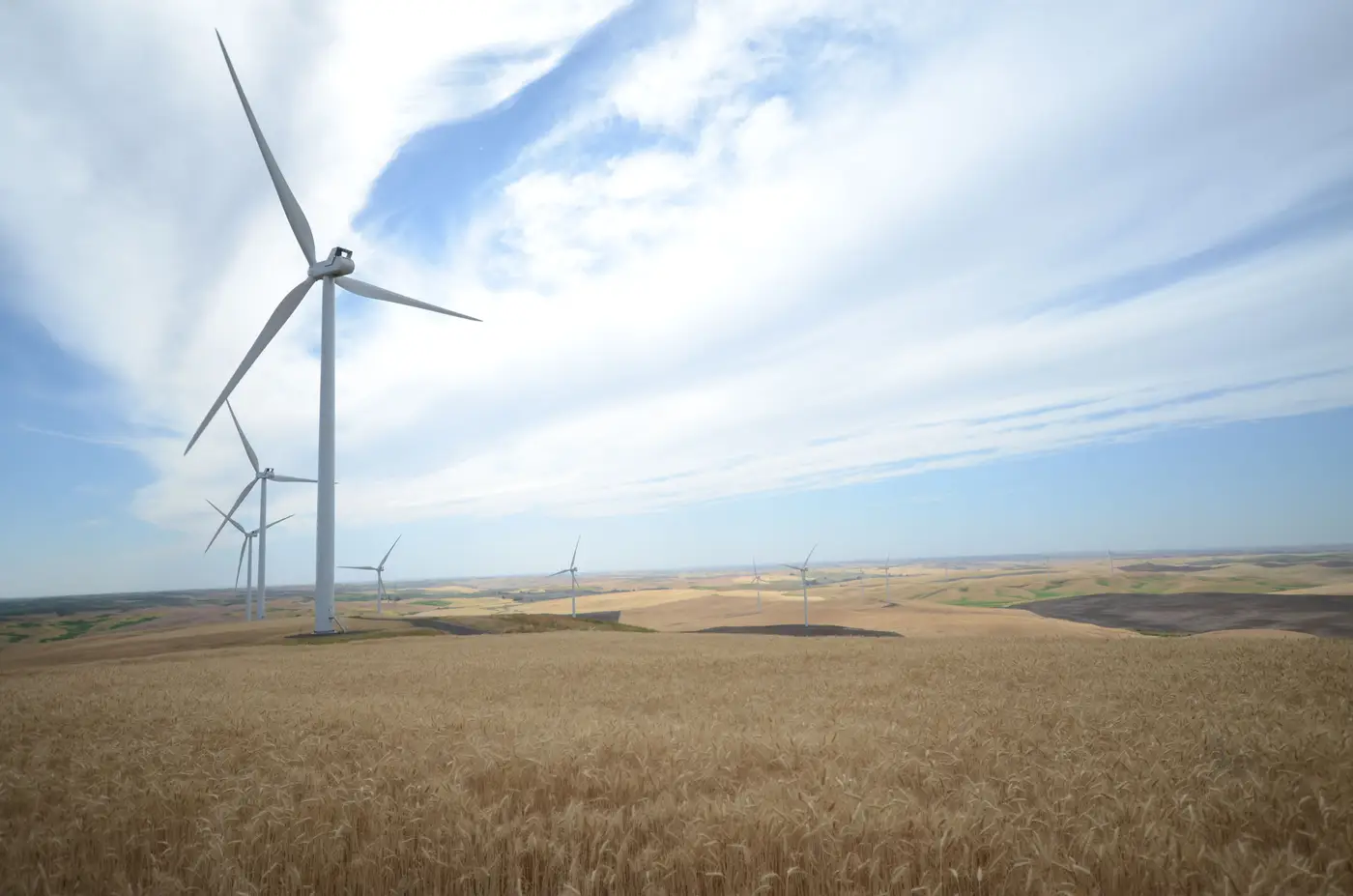
A met mast going up on a candidate site means someone is measuring wind. A foundation pour means someone already has a permit, a turbine order, and probably a PPA. Mixing the two up when you're scanning imagery on a site you've been eyeing for eighteen months is an expensive way to misread how far behind you are.
Both show up as a new light-colored disturbance in a field that was clean last quarter. From there the resemblance stops.
What a met mast looks like from above
A met mast is a thin pole, usually 60 to 100 meters, held up by three or four sets of guy wires anchored in a radial pattern around the base. From VHR imagery that radial pattern is the tell: you'll see a small cleared pad at the center and three or four short spur tracks running out to anchor points, like spokes. The footprint is tiny, often under half an acre of total disturbance including the access track cut in from the nearest farm road.
There's no concrete pour visible, no rebar staging, no crane pad. Just a pole, guy-wire anchors, and sometimes a small equipment shed if it's an instrumented mast logging wind speed and direction data. A met mast tells you a developer is still in the resource-assessment phase. They haven't committed capital at a level that locks the site. It's a flag worth noting, not a reason to pull your bid.
What a foundation pour looks like above
A turbine foundation is a different animal. You're looking at a circular or octagonal cleared area 25 to 35 meters across, graded flat, usually with a much larger adjacent hardstand for the crane, sometimes 60 by 80 meters or more. The access road leading to it is wider and straighter than a met mast spur track, built to carry blade transport and crane sections, not just a pickup truck.
Rebar cages read as a gridded texture in VHR imagery before the pour, and after the pour the pad itself shows as a flat, uniform gray disc distinct from the surrounding graded soil. If you see one of these pads with a crane hardstand next to it and a widened haul road connecting back to the public road network, somebody has already secured interconnection, permits, and turbine supply, and the project is under construction.
Why the order matters for your bid
The gap between these two signals is the whole ballgame for a BD team. A met mast on a site you're tracking means a competitor is interested, but the clock hasn't really started. You still have time to work landowner options, firm up your own interconnection queue position, or decide the site isn't worth the fight. A foundation pour means the clock already ran out. Whatever capital you'd spend chasing that site is capital spent on a site someone else is going to energize.
The confusion usually happens because both start with cleared ground and a new access track, and a BD analyst scanning a quarterly pass for the first time doesn't always know what to look for in the footprint shape. Once you've seen the radial guy-wire pattern next to the circular pour pad a few times, the two stop looking anything alike.
This is exactly the kind of read that benefits from a repeatable process instead of a one-off squint at an image. A quarterly, dated change flag across your whole watch list means you catch the met mast the pass after it goes in, and you catch the foundation pour before your team has sunk another round of landowner outreach into a site that's already spoken for.
If your BD process still runs on someone driving past a site to check, it's worth comparing that to a quarterly flag across every candidate site you're tracking at once.